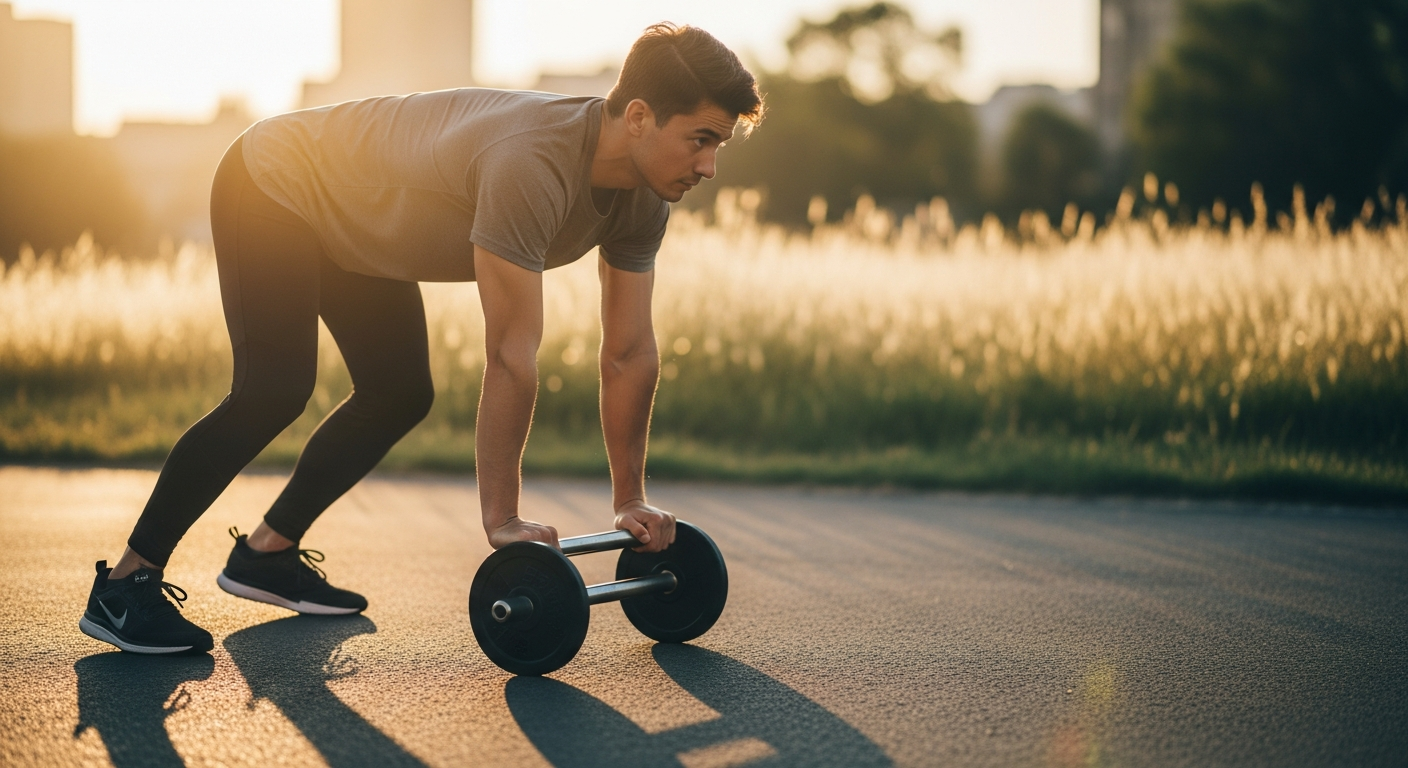
Functional Fitness for Real Life
Why training for real-world movement matters more than gym PRs. A practical guide to building strength, mobility, and everyday resilience.
 The Rooted Glow Team
 A few years ago, one of our team members could deadlift 315 pounds. Impressive on paper. But he threw out his back picking up a suitcase at the airport.
That moment was a wake-up call. He was strong in a gym, under controlled conditions, with perfect form, on a barbell that moves in a single plane. But his body wasn’t prepared for the unpredictable, multi-directional demands of everyday life.
That’s the gap functional fitness fills.
What Is Functional Fitness?
Functional fitness is training that prepares your body for real-world movements. Carrying groceries. Playing with your kids on the floor. Reaching for something on a high shelf. Getting up from the ground without assistance. Moving furniture. Hiking uneven terrain.
These activities require a combination of strength, mobility, balance, coordination, and stability that traditional gym routines (chest day, back day, leg day) often neglect.
Functional fitness isn’t anti-gym. It’s a philosophy that asks a simple question: does this exercise make me better at living my life?
The Principles
Multi-joint, multi-plane movements. Real life doesn’t happen in a single plane of motion. You twist, reach, squat, lunge, carry, and push in every direction. Functional training reflects that.
Core stability over core aesthetics. A six-pack looks nice, but what matters for daily life is a core that stabilizes your spine during movement. Planks and carries beat crunches for functional core strength.
Mobility alongside strength. Strength without mobility is a liability. If you can squat 300 pounds but can’t sit cross-legged on the floor, something is wrong.
Balance and proprioception. Your body’s ability to sense where it is in space (proprioception) degrades with age unless you actively train it. Single-leg exercises, uneven surfaces, and balance challenges maintain this crucial system.
Grip strength. Often overlooked, grip strength is one of the strongest predictors of overall health and longevity. It’s also essential for carrying, lifting, opening, and holding things in daily life.
The Foundational Movements
Every functional fitness program should build competence in these movement patterns:
Squat
You squat every time you sit down, pick something up from the floor, or play with a pet. It’s the most fundamental human movement pattern.
How to train it. Bodyweight squats, goblet squats, front squats. Focus on depth (can you get your hips below your knees?) and control.
Hinge
Bending at the hips to pick something up. Deadlifts are the gym version, but the hinge pattern shows up every time you lift a box, put away dishes, or bend to tie your shoes.
How to train it. Romanian deadlifts, kettlebell swings, good mornings. The key is learning to bend at the hips while keeping a neutral spine.
Push
Pushing a door open, getting up from the floor, pressing something overhead.
How to train it. Push-ups, overhead press, dips. Both horizontal (push-up) and vertical (overhead press) pushing patterns matter.
Pull
Opening a heavy door, pulling yourself up or over something, rowing a kayak.
How to train it. Pull-ups, rows, face pulls. If you can’t do a pull-up yet, that’s a worthy goal. We have a guide on strength training without a gym that includes a pull-up progression.
Carry
Carrying groceries, luggage, children, furniture. Loaded carries train your grip, core, shoulders, and legs simultaneously.
How to train it. Farmer’s walks (carry heavy things and walk). Suitcase carries (one-sided). Overhead carries. These are unglamorous and brutally effective.
Rotate
Twisting to look behind you, throwing a ball, swinging a golf club.
How to train it. Cable rotations, medicine ball throws, Turkish get-ups. Most gym routines completely ignore rotational training, which is why so many people hurt their backs during twisting movements.
Get Up and Down from the Floor
This one surprises people. The ability to get up from the floor without using your hands is correlated with longevity in research. It tests strength, mobility, balance, and coordination simultaneously.
How to train it. Turkish get-ups, ground-to-standing transitions, rolling patterns. Just practice getting up and down from the floor in different ways.
Building a Functional Routine
Here’s a simple weekly framework:
Day 1: Push + Core
- Push-ups (3 sets of 8 to 15)
- Overhead press with dumbbells or kettlebells (3 sets of 8 to 10)
- Plank holds (3 sets of 30 to 60 seconds)
- Pallof press (3 sets of 10 per side)
Day 2: Pull + Carry
- Pull-ups or inverted rows (3 sets of 5 to 10)
- Single-arm dumbbell row (3 sets of 10 per side)
- Farmer’s walks (3 rounds of 40 meters)
- Dead hangs (3 sets, hang as long as possible)
Day 3: Squat + Hinge
- Goblet squats (3 sets of 10 to 12)
- Romanian deadlifts (3 sets of 8 to 10)
- Walking lunges (3 sets of 10 per leg)
- Kettlebell swings (3 sets of 15)
Day 4: Mobility + Balance
- Full mobility routine (see our morning mobility routine)
- Single-leg Romanian deadlifts (3 sets of 8 per side)
- Turkish get-ups (3 per side)
- Barefoot balance work (stand on one leg, eyes closed, 30 seconds per side)
Day 5 to 7. Walk. Play. Move in unstructured ways. Go for a hike. Throw a frisbee. Swim. Ride a bike. The best “exercise” on rest days is walking.
Functional Fitness vs. Traditional Gym Training
We’re not saying bench press and bicep curls are useless. They build muscle and look great. But if your training is exclusively machine-based, single-plane, and seated, you’re leaving functional capacity on the table.
The comparison:
| Traditional Gym | Functional Approach |
|---|---|
| Leg press machine | Goblet squat |
| Seated cable row | Standing single-arm row |
| Lat pulldown | Pull-up |
| Ab crunch machine | Pallof press + farmer’s walk |
| Seated shoulder press | Standing overhead press |
The functional versions are harder because they require stability, balance, and core engagement. That’s the point. Real life doesn’t provide a padded seat and a guided track.
Equipment You Actually Need
Good news: functional fitness requires minimal equipment.
The essentials:
- One kettlebell (a 16kg/35lb for most men, 12kg/25lb for most women is a versatile starting weight)
- A pull-up bar (doorframe versions work fine)
- Your body
Nice to have:
- A set of resistance bands
- A pair of adjustable dumbbells
- A jump rope
That’s it. No cable machines. No leg press. No gym membership required, though gyms are great if you enjoy them.
Common Misconceptions
“Functional fitness is just CrossFit.” CrossFit incorporates functional movements, but functional fitness is broader and doesn’t require high-intensity competition or barbells.
“I need to be fit first.” Functional fitness scales to any level. Can’t do a push-up? Start on your knees or against a wall. Can’t squat deep? Squat to a chair. Every movement has a regression.
“This won’t build muscle.” It absolutely will. Goblet squats, pull-ups, and kettlebell swings build substantial muscle. You might not look like a bodybuilder, but you’ll look strong and move like an athlete.
“It’s only for young people.” Functional fitness becomes more important with age, not less. The ability to get off the floor, carry things, and maintain balance directly affects quality of life in older adults.
Getting Started
- Assess your basics. Can you do a full squat with your heels on the ground? Can you hang from a bar for 30 seconds? Can you get up from the floor without using your hands? These tests reveal your starting points.
- Start with mobility. If your joints don’t move well, loading them with weight is counterproductive. Spend 2 weeks focusing on our 15-minute morning mobility routine before adding strength work.
- Master bodyweight first. Before adding kettlebells or dumbbells, own the basic movement patterns with just your body. Good squats, push-ups, and rows with perfect form.
- Add load gradually. When bodyweight movements become easy (15+ reps with control), add external weight.
- Walk daily. Seriously. Walking is the most underrated exercise in existence, and it supports everything else.
Further Reading
This is our movement hub. Explore these topics:
Keep Reading
Strength Training Without a Gym
How to build real strength at home or outdoors with minimal equipment. bodyweight progressions, kettlebell essentials, and a no-gym program that works.

Walking for Health: The Most Underrated Exercise
Why walking might be the single best thing you can do for your health. the research, the benefits, and how to make it count.
Morning Mobility Routine: 15 Minutes to Move Better
A simple 15-minute morning mobility routine that loosens stiff joints, improves posture, and sets your body up for a better day.
Stay Rooted
Weekly reads on whole-food nutrition, movement, and the K-Beauty routines we actually use. No spam, no fluff. just things worth reading.