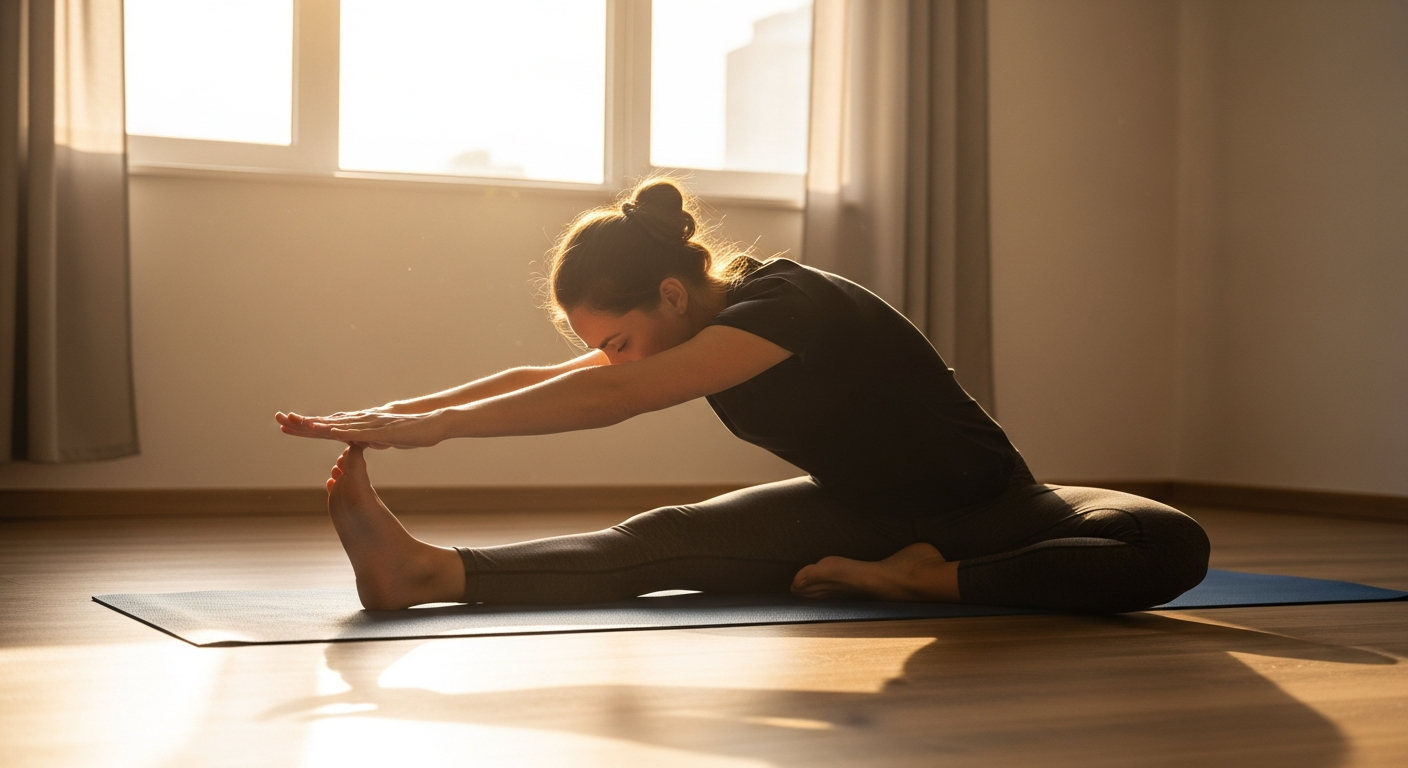
Morning Mobility Routine: 15 Minutes to Move Better
A simple 15-minute morning mobility routine that loosens stiff joints, improves posture, and sets your body up for a better day.
 The Rooted Glow Team
 Most of us wake up stiff. Shoulders rolled forward from sleeping on our sides. Hips tight from eight hours in a fetal position. Lower back locked up. Ankles that crack with every step.
For a long time, we just accepted this. “I’m getting older,” we told ourselves. “This is just how mornings feel.”
Then we started doing 15 minutes of mobility work every morning. Within two weeks, the stiffness was gone. Within a month, we were moving better than we had in years. Not just in the morning, but all day.
This routine has become non-negotiable for our team. It’s the single habit that improved our daily quality of life more than any supplement, gadget, or gym session.
Mobility vs. Flexibility: A Quick Distinction
Flexibility is the ability of a muscle to lengthen passively (someone pushing your leg into a stretch). Mobility is the ability to actively move a joint through its full range of motion under control.
Mobility is what matters for real life. You don’t need someone to push your hip into position when you’re playing with your kids on the floor. You need your hip to move there on its own.
This routine trains active mobility. You’ll stretch, yes, but you’ll also move through ranges of motion in a controlled way that teaches your nervous system to “own” those positions.
The Routine
Do these in order. Each movement flows into the next. Total time: 15 minutes. No equipment needed, just a floor.
1. Cat-Cow (90 seconds)
What it does. Wakes up the entire spine. Mobilizes each vertebral segment from tailbone to neck.
How to do it:
- Start on hands and knees (tabletop position)
- Inhale: drop your belly, lift your chest and tailbone (cow)
- Exhale: round your spine, tuck your chin and tailbone (cat)
- Move slowly. Try to articulate each segment of the spine rather than moving as one rigid block
- Do 10 to 12 slow repetitions
Key cue. Imagine your spine is a wave. The movement starts at the pelvis and ripples up to the head.
2. World’s Greatest Stretch (2 minutes per side)
What it does. Hits the hip flexors, thoracic spine, hamstrings, groin, and shoulders in one sequence. There’s a reason it has the name it does.
How to do it:
- Step your right foot forward into a deep lunge
- Place your left hand on the ground inside your right foot
- Rotate your right arm up toward the ceiling, following your hand with your eyes
- Hold the rotation for 3 breaths
- Bring your right hand back down
- Push your hips back, straighten your front leg, and fold toward your shin for a hamstring stretch
- Hold for 3 breaths
- Return to lunge position and repeat 3 times per side
Key cue. During the rotation, think about opening your chest to the sky, not just reaching your arm up.
3. 90/90 Hip Switches (2 minutes)
What it does. Mobilizes the hips through internal and external rotation. If you sit at a desk, this is arguably the most important movement in the routine.
How to do it:
- Sit on the floor with both knees bent at 90 degrees, feet flat
- Drop both knees to the right so your right leg is in external rotation and your left is in internal rotation
- Sit tall (don’t lean back)
- Lift your knees and switch to the other side
- 10 controlled switches
Key cue. Your knees should drop to the floor (or as close as you can get). If they float high, that’s a sign your hips need this badly. It improves fast.
4. Deep Squat Hold (90 seconds)
What it does. Opens the hips, ankles, and lower back. This is a resting position that humans have used for millennia. The fact that most adults in Western countries can’t hold a deep squat comfortably says more about our lifestyle than our anatomy.
How to do it:
- Stand with feet slightly wider than shoulder width, toes turned out slightly
- Squat as deep as you can, keeping your heels on the ground
- Hold the bottom position. Use your elbows to gently push your knees outward
- Breathe. Relax into the position. Try to spend 60 to 90 seconds here
Modification. If you can’t hold a deep squat with heels down, hold onto a doorframe or sturdy furniture for balance. Or place a rolled towel under your heels. You’ll improve quickly with daily practice.
5. Thoracic Spine Rotation (90 seconds per side)
What it does. Opens up the mid-back, which is chronically locked up in anyone who sits at a computer.
How to do it:
- Lie on your side with both knees stacked and bent at 90 degrees
- Extend your arms in front of you, palms together
- Keeping your knees stacked and still, slowly open your top arm like a book, rotating your upper body until that hand reaches (or approaches) the floor on the other side
- Follow your hand with your eyes
- Return slowly
- 8 repetitions per side
Key cue. The rotation should come from your mid-back, not your lower back. Your knees stay stacked and still throughout.
6. Shoulder CARs (1 minute per side)
What it does. CARs (Controlled Articular Rotations) take your shoulder joint through its full range of motion. This maintains joint health and reveals any restrictions.
How to do it:
- Stand tall, arm at your side
- Slowly raise your arm forward and up overhead (imagine tracing a path on the wall beside you)
- Continue the circle: arm goes overhead, behind you, and down
- Move as slowly as possible. When you hit a sticking point, slow down further
- 3 circles forward, 3 circles backward, each side
Key cue. Keep the rest of your body still. Only the shoulder moves. If you have to lean or twist to get your arm overhead, that’s information about your shoulder mobility.
7. Ankle Circles and Calf Stretch (1 minute per side)
What it does. Ankle mobility directly affects squat depth, walking gait, and knee health. It’s almost always overlooked.
How to do it:
- Stand on one leg (hold a wall for balance)
- Circle the free ankle slowly, 10 times in each direction
- Then, step that foot forward, knee over toes, and push gently into a calf stretch
- Hold 30 seconds
8. Dead Hang (60 seconds total)
What it does. Decompresses the spine after a night of sleep. Opens the shoulders. Builds grip strength. Dr. John Kirsch, an orthopedic surgeon, recommends hanging as a treatment for shoulder impingement, and we’ve found it transformative for upper body mobility.
How to do it:
- Find a pull-up bar (or any sturdy overhead bar, playground equipment, door frame bar)
- Hang with straight arms, shoulders relaxed
- Let gravity do the work
- Aim for 60 seconds total. Break it into sets if needed (3 sets of 20 seconds is fine)
Modification. If you can’t hang your full bodyweight, keep your feet on the ground and remove just enough weight to feel a stretch.
Making It a Habit
This routine works because it’s short enough to do daily and effective enough to produce real changes. Here’s how we made it stick:
Do it immediately after waking. Before coffee, before your phone, before anything. Roll out of bed and onto the floor. Once you’ve checked emails or scrolled social media, the window closes.
Same order every day. The sequence is designed to flow. Once your body learns the order, it becomes automatic. You stop thinking and just move.
Track it simply. We use a basic habit tracker. An X on the calendar each day we do it. The streak becomes motivating.
Accept imperfect sessions. Some mornings you’ll be tight and the movements will feel limited. That’s fine. Showing up stiff is exactly when you need this most.
What Changes
Week 1. You’ll feel looser after each session, but the stiffness returns by the next morning. This is normal.
Week 2. The baseline shifts. You wake up less stiff than you did before starting.
Week 3 to 4. Positions that were challenging (deep squat, thoracic rotation) become easier. You start noticing better posture throughout the day without consciously trying.
Month 2 onward. Movement quality improves across the board. Squats feel deeper. Shoulders feel freer. Lower back pain (if you had any) often decreases significantly.
Our teammate who could barely hold a deep squat for 10 seconds now sits comfortably in one while scrolling his phone. That change happened in about six weeks of daily practice.
Pairing with Other Training
This routine is designed to complement, not replace, your training. Think of it as maintenance for your movement hardware.
It pairs well with:
- Strength training (mobility supports better form and deeper ranges)
- Walking (loose hips and ankles make walking more comfortable)
- Any sport or activity (better mobility means better performance and fewer injuries)
For the broader picture of how movement fits into a wellness practice, see our functional fitness guide.
Fifteen minutes. Every morning. It’s the best investment in your body that we’ve found.
Keep Reading
Strength Training Without a Gym
How to build real strength at home or outdoors with minimal equipment. bodyweight progressions, kettlebell essentials, and a no-gym program that works.

Walking for Health: The Most Underrated Exercise
Why walking might be the single best thing you can do for your health. the research, the benefits, and how to make it count.

Functional Fitness for Real Life
Why training for real-world movement matters more than gym PRs. A practical guide to building strength, mobility, and everyday resilience.
Stay Rooted
Weekly reads on whole-food nutrition, movement, and the K-Beauty routines we actually use. No spam, no fluff. just things worth reading.