Hair Oil Secrets from Korea
How Korean beauty approaches hair oil differently. the ingredients, techniques, and products that transformed our hair from dry and brittle to soft and shiny.
 The Rooted Glow Team
 Korean women have been using hair oils for centuries. Long before serums, leave-in conditioners, and heat protectant sprays existed, Korean grandmothers were running camellia oil through their hair daily. The result was the kind of glossy, heavy, healthy hair you see in historical paintings and period dramas. That hair wasn’t a genetic miracle. It was maintained with oil.
Modern Korean hair care has taken this tradition and refined it with science, creating products and techniques that address everything from dry ends to scalp health to heat damage. After spending a year experimenting with Korean hair oils and methods, we’re convinced this is one of the most underappreciated areas of K-beauty.
The Korean Approach to Hair Oil
Western hair care tends to treat oil as a problem. Oily roots, greasy hair, the need for dry shampoo. The goal is often to remove oil, strip buildup, and achieve that squeaky-clean feeling.
Korean hair care flips this. Oil is medicine for hair. The right oil, applied correctly, makes hair stronger, softer, shinier, and more resilient. The key phrase is “the right oil, applied correctly,” because technique matters as much as the product.
The Philosophy
Scalp health comes first. Korean hair care treats the scalp like an extension of the face. A healthy scalp produces healthy hair. Dry, flaky, or clogged scalps produce weak, dull hair. Some oils are specifically for the scalp. Others are for the hair shaft. Using them interchangeably is a common mistake.
Prevention over repair. Applying oil before heat styling, before sun exposure, and before swimming protects the hair from damage that no amount of deep conditioning can fully undo.
Lightweight layering. Like Korean skincare, the approach is light layers rather than heavy application. A few drops of oil distributed through damp hair weighs nothing and adds shine. A palmful of heavy oil weighs hair down and looks greasy.
The Oils
Camellia Oil (Dongbaek-gi-reum)
This is the traditional Korean hair oil, and for good reason. Pressed from the seeds of the Camellia japonica plant (the same camellia that produces green tea), it has a molecular structure remarkably similar to human sebum.
Benefits:
- Absorbs quickly without leaving heavy residue
- Rich in oleic acid, which penetrates the hair shaft (unlike silicones that coat the surface)
- Contains vitamins A, B, D, and E
- Protects against UV damage
- Softens and detangles
- Adds a natural, not greasy, shine
Camellia oil has been the standard hair oil in Korea, Japan, and parts of China for over a thousand years. Geisha in Japan used it daily. Korean noblewomen considered it essential.
We tested pure camellia oil (cold-pressed, unrefined) for three months. The results were clear: softer hair, fewer split ends, more natural movement, and a subtle shine that looked healthy rather than product-laden.
How to use it. 3 to 5 drops (more for thick or long hair, less for fine or short hair) rubbed between palms and distributed through damp hair, focusing on the mid-lengths and ends. Avoid the roots unless your scalp is dry. Can also be used as an overnight treatment: apply more generously, wrap hair in a silk scarf, wash out in the morning.
Argan Oil
Not Korean in origin (it’s from Morocco), but widely adopted in K-beauty hair formulations. Argan oil is lighter than coconut oil but heavier than camellia oil.
Best for. Thick, coarse, or very dry hair. Excellent for taming frizz in humid climates.
How to use it. 2 to 4 drops on damp or dry hair. Works well as a finishing oil after styling.
Jojoba Oil
Another non-Korean oil that’s found its way into many K-beauty hair products. Jojoba is actually a liquid wax, not a true oil, and its structure is the closest match to human sebum of any plant-derived oil.
Best for. All hair types, especially oily scalps (counterintuitively, applying jojoba to an oily scalp can help regulate sebum production). Also excellent for scalp massage.
How to use it. For scalp treatments: warm a tablespoon between your palms, massage into scalp for 5 minutes, leave for 30 minutes to overnight, then wash out. For hair: 2 to 3 drops on damp ends.
Rice Bran Oil
A traditional East Asian oil that’s gaining modern popularity. Rice bran oil contains gamma-oryzanol, a compound with antioxidant and UV-protective properties, along with ferulic acid and vitamin E.
Best for. Fine hair that gets weighed down by heavier oils. Rice bran oil is one of the lightest options available.
How to use it. 3 to 4 drops through damp hair. Also works well mixed into a hair mask.
Techniques
The Pre-Wash Oil Treatment
This is the technique that surprised us most. Applying oil to dry hair before shampooing (not after) protects the hair from the stripping effects of surfactants in shampoo.
Water causes hair to swell (a process called hygral fatigue). Repeated swelling and drying weakens the hair shaft over time. Coating hair with oil before washing creates a hydrophobic barrier that reduces water penetration, limiting this damage.
How to do it:
- Apply camellia or jojoba oil generously to dry hair, focusing on ends and mid-lengths
- Massage a small amount into the scalp
- Leave for 20 to 30 minutes (or overnight for a deep treatment)
- Shampoo as normal (you may need to shampoo twice to remove the oil fully)
- Condition as usual
We do this once per week. The difference in how our hair feels post-wash is noticeable. Softer, less tangled, and without the dry, flyaway texture that regular washing sometimes produces.
The Damp-Hair Application
The most common daily use of hair oil. After washing, towel-dry your hair until it’s damp (not dripping). Apply a few drops of oil and distribute evenly.
The water on your hair helps the oil spread more evenly and absorb more fully. Think of it like applying skincare to a damp face.
Scalp Massage with Oil
Korean scalp care is its own discipline. A weekly scalp massage with oil:
- Increases blood circulation to hair follicles
- Loosens and removes sebum plugs and buildup
- Delivers nutrients directly to the scalp
- Feels incredible (seriously, it’s deeply relaxing)
How to do it:
- Part your hair in sections
- Apply jojoba or camellia oil directly to the exposed scalp
- Using your fingertips (not nails), massage in small circular motions
- Cover the entire scalp over 5 to 10 minutes
- Leave the oil on for 30 minutes to overnight
- Wash out with shampoo
Heat Protection
Before using a blow dryer, flat iron, or curling iron, apply a thin layer of oil to damp or dry hair. The oil creates a barrier that reduces thermal damage.
Camellia oil is particularly effective here because its smoke point is relatively high (about 485°F / 252°C), meaning it remains stable at typical styling temperatures.
This doesn’t replace a dedicated heat protectant spray for very high-heat styling, but for moderate blow-drying, it’s a natural and effective alternative.
Common Mistakes
Using too much oil. Start with 2 to 3 drops. You can always add more. You can’t easily remove excess oil without re-washing.
Applying to roots when you have an oily scalp. Oil on the ends, oil on the scalp only if it’s dry or for a dedicated scalp treatment that you’ll wash out.
Using coconut oil alone. Coconut oil is a popular recommendation, but it sits on the hair surface rather than penetrating the shaft (in most hair types). For fine or straight hair, it can cause buildup and actually make hair feel stiff. Camellia and jojoba penetrate better for most people.
Skipping the scalp. Healthy hair grows from a healthy scalp. If you’re only treating the hair shaft and ignoring the scalp, you’re missing half the equation.
Expecting overnight miracles. Like all good K-beauty practices, hair oil results compound over time. Give it a month of consistent use before judging.
Product Recommendations
Pure camellia oil. Oshima Tsubaki (Japanese, the gold standard), or any cold-pressed, unrefined camellia oil. Korean brand Innisfree also makes a good camellia hair serum.
Lightweight finishing oil. Mise en Scene Perfect Serum. One of the best-selling hair products in Korea for years. A silicone-oil blend that adds instant shine without weight. Not purely natural, but effective and affordable.
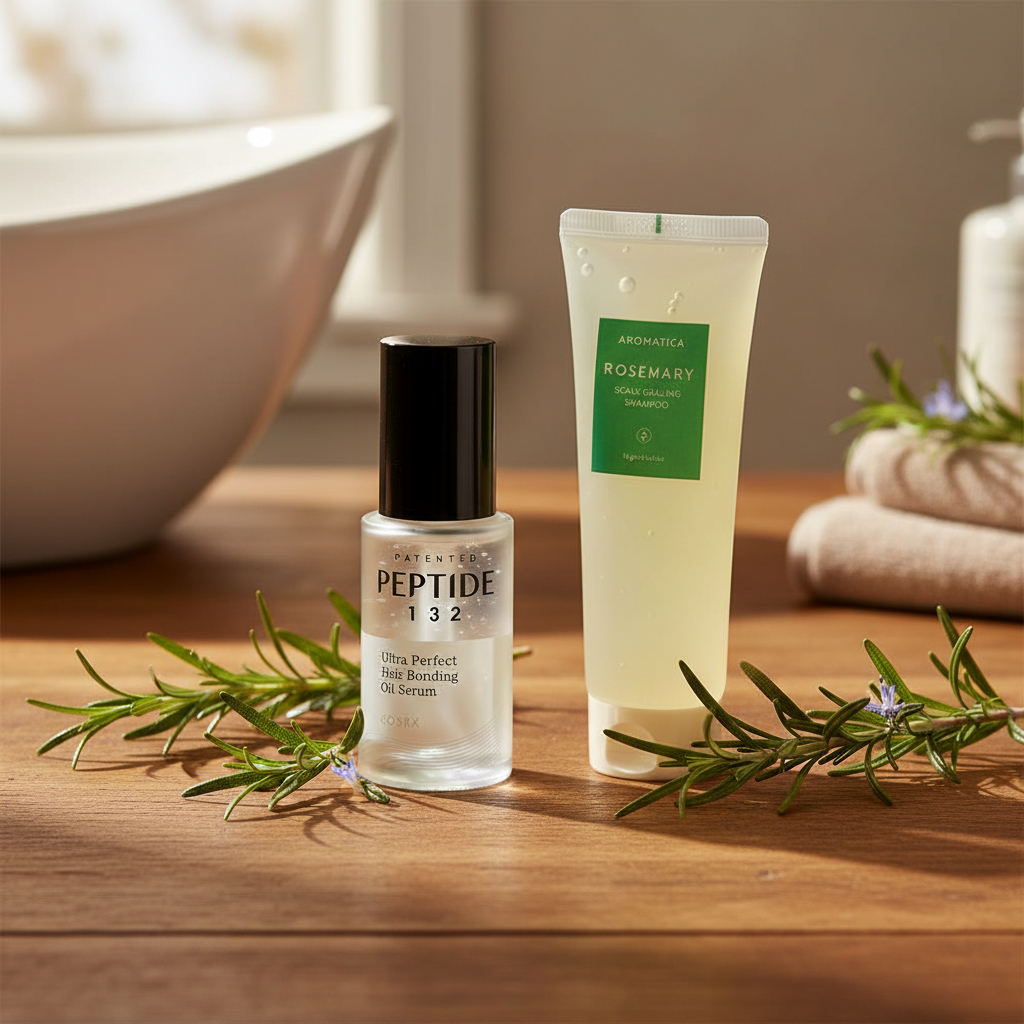
Scalp treatment oil. Aromatica Rosemary Scalp Scaling Shampoo paired with their Rosemary Root Enhancer. The rosemary promotes circulation and the formula targets scalp health directly.
For maintaining moisture and thickness between washes, the AROMATICA Rosemary Hair Thickening Conditioner pairs well with any oil routine. We noticed less breakage and more body after a few weeks of consistent use.
Multi-use oil. Lador Perfect Hair Fill-Up. A protein and oil treatment that’s applied before or after shampooing. Excellent for damaged or color-treated hair.
Building a Hair Oil Routine
Daily. 2 to 3 drops of camellia or jojoba oil on damp hair after washing or on dry hair to smooth flyaways. On days between washes, the AROMATICA Replenishing Hair Mist is a quick way to refresh and add light hydration without weighing hair down.
Weekly. Pre-wash oil treatment (20 to 30 minutes before shampooing) and a scalp massage with oil.
Monthly. An overnight deep oil treatment. Apply generously, wrap in a silk scarf, wash out in the morning.
This is low-effort, low-cost, and the results build steadily. After a month of consistent oil use, our hair was measurably softer (yes, we did an informal “touch test” with friends who didn’t know we’d changed anything). After three months, split ends were reduced and hair looked healthier under any lighting.
Korean grandmothers figured this out centuries ago. The rest of us are just catching up.
Keep Reading
My Complete AM Wellness Routine
The exact morning routine our team follows. from waking up to walking out the door. skincare, movement, nutrition, and the small habits that set the tone.
Double Cleansing: Why and How
The Korean skincare technique that changed how we wash our faces. what it is, why it works, and how to do it without overcomplicating things.

Why Korean Sunscreen Is Different
What makes Korean sunscreens better than most Western options. The formulation differences, the texture revolution, and why it matters.
Stay Rooted
Weekly reads on whole-food nutrition, movement, and the K-Beauty routines we actually use. No spam, no fluff. just things worth reading.