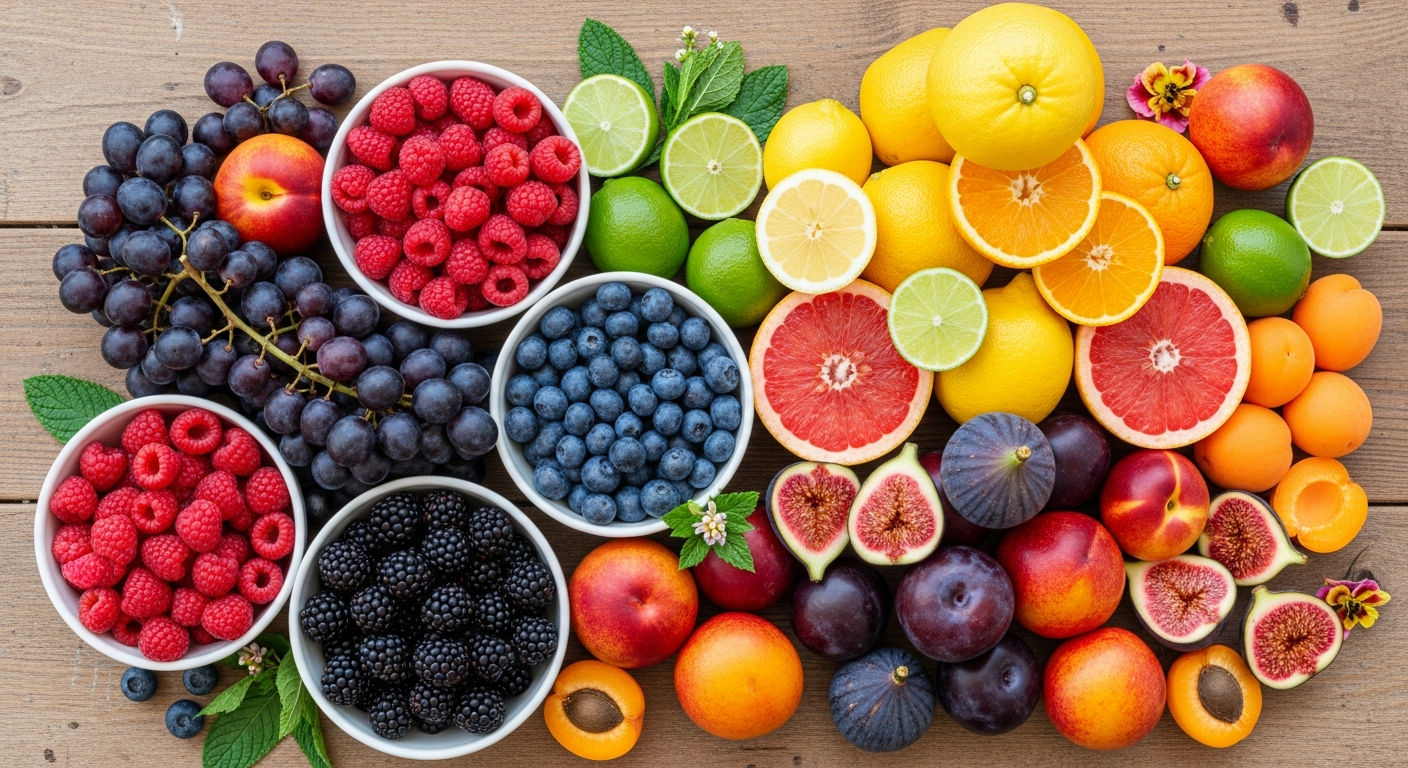
Seasonal Fruit Guide: What to Eat Each Month
A month-by-month guide to eating fruit in season. what's ripe, what tastes best, and why seasonal eating makes a difference for your health and your wallet.
 The Rooted Glow Team
 There’s a specific moment in late June when you bite into a perfectly ripe peach, the kind where the juice runs down your wrist and the flavor is so intense it barely tastes like the same species as the hard, mealy thing you bought at the grocery store in January.
That moment is what seasonal eating is about.
For most of human history, people ate fruit when it was available, which meant in season and from nearby. There was no flying blueberries from Chile in December or importing mangoes year-round. You ate what the land produced, when it produced it.
Modern supply chains changed that. You can now buy almost any fruit at any time of year. But “available” and “worth eating” are different things. Out-of-season fruit is typically picked unripe, shipped long distances, and stored in controlled atmospheres. It looks correct. It doesn’t taste correct. And nutritionally, it’s often a shadow of its in-season counterpart.
Why Seasonal Fruit Matters
Flavor
This is the most immediate difference. Fruit that ripens on the tree or vine, in its natural climate and season, develops sugars, acids, and aromatic compounds that cold-storage fruit never achieves. A January strawberry from a greenhouse tastes like water compared to a June strawberry from a local farm.
Nutrition
A 2004 study published in the Journal of Agricultural and Food Chemistry found that broccoli grown in season had up to twice the vitamin C content of out-of-season broccoli. Similar patterns have been documented for fruits: nutrient content peaks when the fruit matures in its natural season.
Specifically, antioxidant levels (anthocyanins, flavonoids, carotenoids) tend to be highest in fruit that ripens under natural sunlight at the correct temperature range for that species.
Cost
Basic supply and demand. When a fruit is in peak season locally, there’s more of it available and it doesn’t require expensive international shipping or long-term cold storage. Seasonal fruit at a farmers market is often cheaper than out-of-season fruit at a grocery store, and it tastes dramatically better.
Environmental Impact
Eating seasonally reduces the food miles on your plate. A basket of berries from a farm 30 miles away has a very different carbon footprint than one shipped from another continent.
Connection to Place
There’s something grounding about eating in rhythm with your environment. Knowing that stone fruit means summer is here, that apples signal autumn, that citrus carries you through winter. It reconnects you to natural cycles that modern life has largely erased.
The Month-by-Month Guide
This guide is based on temperate Northern Hemisphere climates (most of the US, Europe, and East Asia). If you’re in a tropical or Southern Hemisphere location, the timing shifts accordingly.
January
In season. Citrus is king. Oranges, grapefruits, tangerines, lemons, limes, blood oranges, kumquats. Pomegranates are at the tail end of their season. Kiwis are available.
Our pick. Blood oranges. The deep crimson flesh, the berry-like sweetness layered over citrus acidity. They’re stunning in salads and extraordinary juiced. Available for only a few weeks.
Tip. This is the month to eat citrus aggressively. Vitamin C stores from summer are depleted, and your immune system needs the support during cold and flu season.
February
In season. Citrus continues strong. Meyer lemons peak. Kumquats. Early rhubarb appears in some regions.
Our pick. Meyer lemons. Sweeter and more floral than regular lemons, with a thin, edible skin. Use them for dressings, baking, or just squeezed over fish.
Tip. Preserved Meyer lemons (salt-packed in a jar for a month) are one of the best condiments you’ll ever make.
March
In season. Late citrus. Rhubarb. Very early strawberries in warmer climates.
Our pick. Rhubarb. Technically a vegetable, treated as a fruit. Tart, vibrant, and signals that spring is coming. Stewed with a bit of honey and served over yogurt is our favorite preparation.
Tip. Freeze rhubarb in chunks for use throughout the year. It freezes beautifully.
April
In season. Strawberries begin (in warmer regions). Loquats. Last of the citrus.
Our pick. The first local strawberries. Small, irregularly shaped, intensely flavored. If you can find them at a farmers market, buy as many as you can carry.
Tip. Early-season strawberries are often smaller and more tart than peak-season ones. They’re excellent macerated with a bit of honey and served over ricotta or yogurt.
May
In season. Strawberries peak. Cherries begin. Apricots start appearing. Mulberries (if you can find them).
Our pick. Cherries. Bing cherries, Rainier cherries, sour cherries for cooking. The cherry window is brief. Don’t miss it.
Tip. Sour cherries (tart, bright red) are incredible for baking and preserving. If you spot them, buy them immediately. They’re available for roughly 2 weeks in most regions.
June
In season. Strawberries (still going), cherries, blueberries, early peaches, apricots, plums.
Our pick. Blueberries. Wild blueberries (smaller, more intense) are nutritionally superior to cultivated ones, with 2 to 3 times the antioxidant content. Fresh blueberries eaten by the handful in June are one of summer’s great pleasures.
Tip. Buy extra blueberries and freeze them flat on a baking sheet. They’re perfect for smoothies, yogurt, and baking throughout the year.
July
In season. Peaches, nectarines, plums, blackberries, raspberries, watermelon, cantaloupe, figs (early).
Our pick. Peaches. A perfectly ripe, in-season peach is transcendent. Look for ones that smell sweet at the stem end and give slightly to pressure. If it smells like nothing, it’ll taste like nothing.
Tip. Peaches on the grill, served with a dollop of Greek yogurt and a drizzle of honey. Takes 3 minutes and tastes like the definition of summer.
August
In season. Figs, late peaches, pears begin, grapes, melons, blackberries, plums continue.
Our pick. Figs. Fresh figs have a honey-like sweetness and a jammy, seed-studded interior that dried figs can’t replicate. Black Mission figs or Kadota figs, eaten within a day or two of picking, are spectacular.
Tip. Figs + soft goat cheese + a drizzle of honey + a crack of black pepper. That’s a complete dessert.
September
In season. Apples, pears, grapes, late figs, pomegranates begin, cranberries start.
Our pick. Apples. Not the Red Delicious of your childhood cafeteria. Find Honeycrisp, Fuji, Pink Lady, or heritage varieties at a farmers market. The difference between a fresh-picked apple and a cold-storage one is night and day.
Tip. Visit an apple orchard if you have one nearby. Pick your own. It’s the kind of activity that sounds corny until you do it and realize it’s genuinely restorative.
October
In season. Apples continue, pears peak, persimmons, pomegranates, cranberries, quince.
Our pick. Persimmons. If you’ve never had a ripe Hachiya persimmon (the acorn-shaped variety), you’re missing out. Wait until it’s soft, almost translucent. The flavor is like caramel and honey. Eat it with a spoon.
Tip. Fuyu persimmons (the flat, squat variety) can be eaten firm, sliced into salads. Hachiya persimmons must be completely soft or they’ll be unbearably astringent.
November
In season. Citrus returns (early tangerines), pomegranates peak, persimmons, pears, cranberries, kiwis.
Our pick. Pomegranates. The seeds (arils) are packed with antioxidants, particularly punicalagins and anthocyanins. Sprinkle them on salads, yogurt, or eat them by the handful.
Tip. To deseed a pomegranate without the mess: cut it in half, hold it cut-side down over a bowl, and smack the back with a wooden spoon. The seeds fall out cleanly.
December
In season. Citrus (tangerines, oranges, grapefruits), pomegranates (late), kiwis, pears (stored).
Our pick. Satsuma tangerines. Easy to peel, seedless, perfectly sweet-tart, and available right when you need a burst of sunshine during the darkest month.
Tip. December is a great month to lean into dried and preserved fruits: dates, dried figs, prunes. These were traditional winter fruits for centuries and remain nutrient-dense and satisfying.
How to Shop Seasonally
Visit a farmers market. Everything there is in season by definition. You’ll discover varieties you’ve never seen in a grocery store.
Learn your region. Every area has its own seasonal calendar based on climate. Search for a local seasonal produce guide online.
Preserve the abundance. When your favorite fruit is at peak season, buy extra and freeze, dry, or preserve it. Summer berries frozen in August taste better in January than any fresh berries available that month.
Accept the gaps. There are months (February, March) when fresh local fruit options are limited. That’s what citrus, dried fruit, and preserved fruit are for. The scarcity makes the abundance sweeter.
Seasonal eating is one of the simplest aspects of ancestral nutrition. You don’t need a plan or a subscription. You just need to pay attention to what’s ripe, buy that, and enjoy it while it lasts.
Keep Reading
Complete Guide to Ancestral Eating
How eating like our great-grandparents. real meat, wild fish, seasonal fruit, and zero seed oils. changed the way we think about food.
Why We Quit Seed Oils (And What We Cook With Instead)
The science behind industrial seed oils, why we removed them from our kitchen, and the traditional fats that replaced them.
15 High-Protein Breakfasts Without Grains
15 quick, high-protein breakfast ideas that keep you full until lunch without grains. No cereal, no toast, no oats. Just real, whole-food fuel.
Stay Rooted
Weekly reads on whole-food nutrition, movement, and the K-Beauty routines we actually use. No spam, no fluff. just things worth reading.