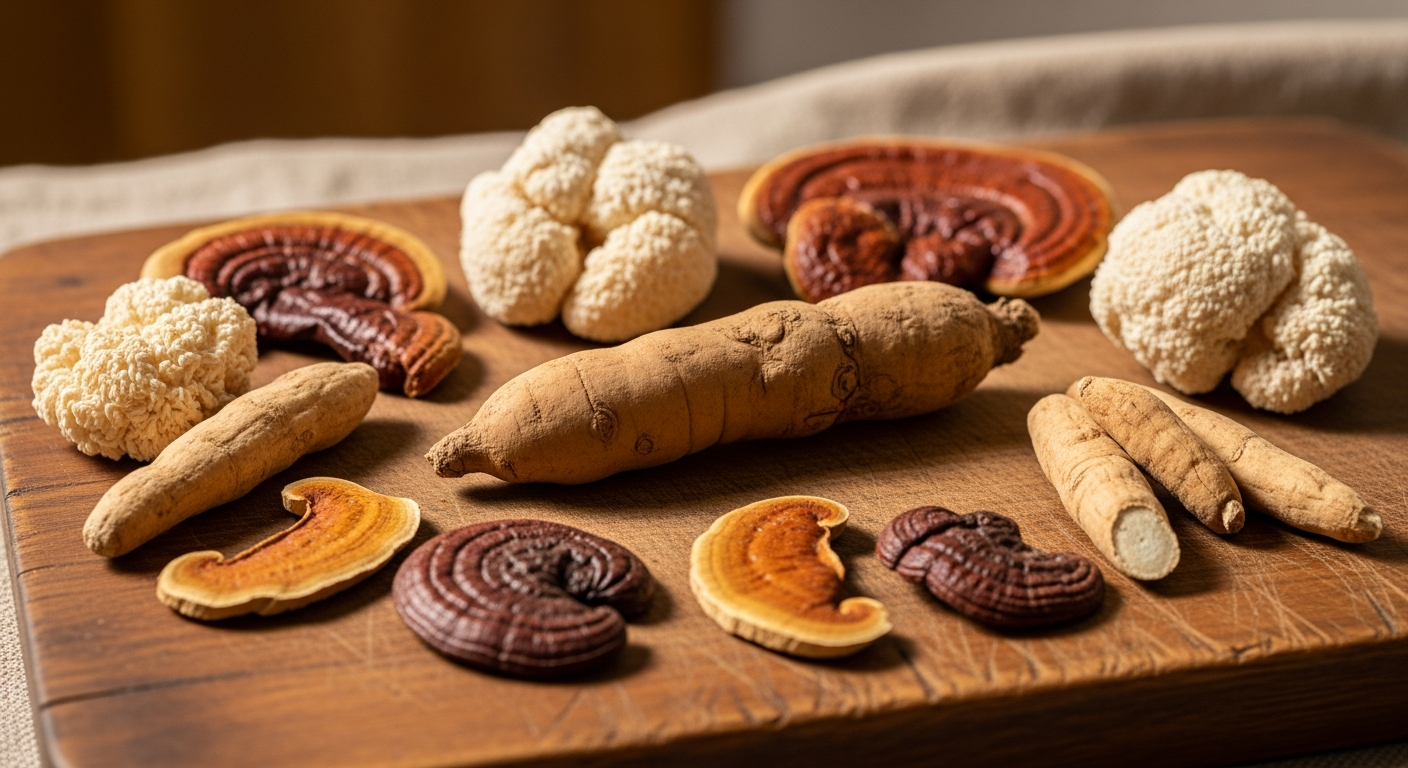
8 Adaptogens That Actually Work
Cutting through the hype: 8 adaptogenic herbs with real research behind them, what they do, how to take them, and what we actually noticed.
 The Rooted Glow Team
 The wellness industry loves adaptogens. Every new supplement brand launches with at least three in their lineup, usually with claims that range from “reduces stress” to what amounts to magical thinking.
We wanted to separate the real from the ridiculous. So we spent six months reading the research, consulting with a naturopathic doctor, and personally testing the adaptogens with the strongest evidence base.
Here’s what we found: some of them work. Genuinely, measurably, noticeably work. And some popular ones have far less evidence than their marketing suggests.
These 8 made the cut.
What Are Adaptogens?
Adaptogens are a class of herbs and mushrooms that help the body adapt to stress by modulating the HPA (hypothalamic-pituitary-adrenal) axis and cortisol production. The term was coined by Soviet scientist Nikolai Lazarev in 1947, and the concept has roots in traditional Chinese medicine and Ayurveda going back thousands of years.
To qualify as an adaptogen, a substance must meet three criteria:
- Non-toxic at normal doses
- Non-specific in action. it helps the body resist a broad range of stressors (physical, chemical, biological)
- Normalizing. it brings the body toward balance rather than pushing it in one direction (calms when you’re wired, energizes when you’re depleted)
That third criterion is what makes adaptogens different from stimulants (which always push up) or sedatives (which always push down). A true adaptogen helps your body find its own equilibrium.
1. Ashwagandha (Withania somnifera)
The evidence. Ashwagandha is the most-studied adaptogen, with dozens of randomized controlled trials. A 2019 systematic review in the Journal of Alternative and Complementary Medicine analyzed 5 RCTs and found that ashwagandha supplementation significantly reduced cortisol levels and improved scores on perceived stress scales.
A 2012 study from the Indian Journal of Psychological Medicine gave participants 300mg of high-concentration ashwagandha root extract (KSM-66) twice daily for 60 days. The treatment group showed a 28% reduction in serum cortisol compared to placebo.
What we noticed. This was the adaptogen with the most obvious subjective effects. After 3 weeks of daily use (600mg KSM-66 extract), our team members reported feeling calmer under pressure, recovering from stressful situations faster, and sleeping more deeply. The sleep improvement was particularly notable.
How to take it. 300 to 600mg of a standardized root extract (KSM-66 or Sensoril are the most-studied extracts), taken with food. Many people take it in the evening due to its calming properties.
Caution. Ashwagandha is a nightshade. If you have nightshade sensitivity, use cautiously. It may also interact with thyroid medication and is not recommended during pregnancy.
2. Rhodiola Rosea
The evidence. Rhodiola is best studied for fatigue, mental performance, and exercise recovery. A 2012 review in Phytomedicine analyzed 11 clinical trials and concluded that rhodiola consistently improved symptoms of physical and mental fatigue.
A particularly interesting study from 2009 (published in Planta Medica) gave stressed, fatigued physicians 170mg of rhodiola extract daily for 2 weeks. The treatment group showed significant improvement in cognitive function, concentration, and short-term memory.
What we noticed. Unlike ashwagandha’s calming effect, rhodiola felt more energizing. Our team used it as a morning supplement and noticed improved mental clarity during demanding work days. One team member described it as “like caffeine without the jitters or the crash.”
How to take it. 200 to 400mg standardized extract (standardized to 3% rosavins and 1% salidroside), taken in the morning on an empty stomach. Don’t take it in the evening; it can be too stimulating for some.
Caution. May interact with antidepressant and anti-anxiety medications. Start with the lower dose.
3. Lion’s Mane (Hericium erinaceus)
The evidence. Lion’s mane is a culinary mushroom with remarkable neuroprotective properties. Its active compounds (hericenones and erinacines) stimulate the production of nerve growth factor (NGF), a protein essential for the growth and maintenance of neurons.
A 2009 double-blind, placebo-controlled study in Phytotherapy Research gave older adults with mild cognitive impairment 250mg of lion’s mane extract three times daily for 16 weeks. The treatment group showed significantly improved cognitive function scores compared to placebo. Notably, the improvements disappeared within 4 weeks of stopping supplementation, suggesting ongoing use is needed.
A 2019 study found that lion’s mane supplementation reduced symptoms of depression and anxiety in overweight or obese patients over 8 weeks.
What we noticed. The cognitive effects were subtle but real. After about 2 weeks of daily use, we noticed clearer thinking during complex tasks and better recall. It’s not a dramatic, feel-it-immediately supplement. It’s more like slowly turning up the resolution on a screen.
How to take it. 500mg to 3g daily of a dual-extracted powder (both hot water and alcohol extraction, to capture both water-soluble and fat-soluble compounds). Can be taken any time of day.
Caution. Lion’s mane is very well-tolerated. Those with mushroom allergies should obviously avoid it.
4. Reishi (Ganoderma lucidum)
The evidence. Reishi has been used in traditional Chinese medicine for over 2,000 years, and modern research supports its role in immune modulation and stress reduction.
A 2012 study in the Journal of Ethnopharmacology found that reishi extract significantly reduced fatigue and improved quality of life in breast cancer patients. A 2005 randomized controlled trial showed that 1,800mg of reishi polysaccharide extract taken for 8 weeks significantly reduced fatigue and improved well-being in neurasthenia patients.
Reishi’s triterpene compounds have also demonstrated anti-inflammatory and calming effects on the nervous system.
What we noticed. Reishi’s effects were most apparent in the evening. We used it as a nighttime tea or supplement and found it promoted a sense of calm that supported the wind-down before sleep. It wasn’t sedating, but it took the edge off evening restlessness.
How to take it. 1,000 to 3,000mg of dual-extracted mushroom powder, or brewed as a tea. Best taken in the afternoon or evening.
Caution. Reishi can thin the blood. If you’re on blood-thinning medication or preparing for surgery, consult your doctor.
5. Tulsi (Holy Basil, Ocimum tenuiflorum)
The evidence. Tulsi is considered one of the most important herbs in Ayurvedic medicine. A 2017 systematic review in Evidence-Based Complementary and Alternative Medicine analyzed 24 clinical studies and concluded that tulsi demonstrated significant effects on metabolic stress (blood glucose, lipids, blood pressure) and psychological stress (anxiety, depression, cognitive function).
A standout study from 2012 gave participants 300mg of tulsi extract twice daily for 6 weeks. The treatment group showed significant improvement in stress-related symptoms including forgetfulness, sexual problems, exhaustion, and sleep quality.
What we noticed. Tulsi as a daily tea became a favorite. It has a pleasant, slightly peppery, clove-like flavor. The calming effect was gentle but consistent. Several team members replaced their afternoon coffee with tulsi tea and found they got through the afternoon without the usual energy dip.
How to take it. As a tea (steep dried tulsi leaves for 5 to 10 minutes), 2 to 3 cups daily. Or as a supplement, 300 to 600mg of extract twice daily.
Caution. May have mild blood-thinning effects. Avoid during pregnancy.
6. Eleuthero (Siberian Ginseng, Eleutherococcus senticosus)
The evidence. Eleuthero was one of the original adaptogens studied by Soviet researchers. It was given to cosmonauts, athletes, and soldiers to improve endurance and stress tolerance.
A 2009 study in the Chinese Journal of Integrative Medicine found that eleuthero extract improved endurance capacity, cardiovascular function, and fat metabolism in recreational athletes. A 2004 study showed improved cognitive function and reduced mental fatigue in volunteers under stress.
What we noticed. Eleuthero felt like a gentle, sustained energy boost without the spike-and-crash of caffeine. Our team member who runs used it before long runs and noticed better endurance. Another used it during a particularly intense work week and reported better sustained focus.
How to take it. 300 to 400mg standardized extract daily, taken in the morning. Often cycled (8 weeks on, 2 weeks off).
Caution. May raise blood pressure in some individuals. Monitor if you have hypertension.
7. Schisandra (Schisandra chinensis)
The evidence. Schisandra is called the “five-flavor berry” in traditional Chinese medicine because it contains all five tastes (sweet, sour, salty, bitter, pungent). It’s been studied for its effects on liver function, physical performance, and stress resilience.
A 2010 study in Phytomedicine found that schisandra extract improved concentration, attention, and speed of cognitive tasks in healthy volunteers. Research published in the Journal of Ethnopharmacology documented its liver-protective (hepatoprotective) effects, which is relevant because your liver processes the majority of toxins and excess hormones.
What we noticed. Schisandra has a unique, tart flavor that works well in tea or mixed into water. The effects were subtle, more of a background sense of resilience than a noticeable shift. Our team member focused on liver health (who had done a toxin-reduction overhaul) felt this was a natural complement to that process.
How to take it. 500mg to 1,500mg of dried berry extract daily, or brewed as a tea. Can be taken any time.
Caution. Generally very well-tolerated. Avoid during pregnancy.
8. Maca (Lepidium meyenii)
The evidence. Maca is a root vegetable from the Peruvian Andes that functions as a mild adaptogen with specific benefits for energy, mood, and hormonal balance.
A 2009 study in Andrologia found that maca improved sexual desire in healthy men after 8 weeks. Research in Menopause (2008) showed that maca reduced symptoms of anxiety and depression in postmenopausal women while also improving sexual function.
A 2016 systematic review found consistent evidence for maca’s positive effects on sexual function and moderate evidence for mood improvement.
What we noticed. Maca has an earthy, slightly nutty flavor that works well in smoothies and coffee. Our team noticed improved energy levels (not a stimulant buzz, more of a baseline increase) and improved mood. One team member who added it to her morning smoothie described it as “feeling more like myself.”
How to take it. 1,500 to 3,000mg of gelatinized maca powder daily (gelatinized is easier to digest than raw). Mix into smoothies, coffee, or oatmeal.
Caution. Maca is a cruciferous vegetable. If you have thyroid issues, consult your doctor before regular use.
How to Start
Don’t buy all 8 at once. That’s expensive, overwhelming, and makes it impossible to tell what’s working.
Step 1. Identify your primary concern:
- Stress and anxiety: start with ashwagandha
- Fatigue and focus: start with rhodiola or lion’s mane
- Sleep and calming: start with reishi or tulsi
- Energy and mood: start with maca or eleuthero
Step 2. Try one adaptogen for 6 to 8 weeks before adding another. Track how you feel with simple daily notes.
Step 3. Many herbalists recommend cycling adaptogens (6 to 8 weeks on, 2 weeks off) to prevent tolerance and maintain effectiveness.
Step 4. Buy from reputable brands that provide third-party testing. Adaptogens are supplements, and the supplement industry has quality control issues. Look for brands that publish their testing results.
What Adaptogens Don’t Replace
Adaptogens are supplements, not substitutes. They support your stress response, but they won’t compensate for:
- Chronic sleep deprivation (fix your sleep first: how to fix your sleep in 7 days)
- A terrible diet
- No physical activity
- Unaddressed mental health issues
- Toxic relationships or work environments
Get the foundations right first. Then adaptogens can amplify an already-healthy baseline.
For the bigger picture of how stress management connects to sleep and skin health, see our wellness triangle guide.
Keep Reading

Toxin-Free Living: Where to Start
A practical guide to reducing daily toxin exposure. The biggest culprits in your home, the swaps that matter most, and how to prioritize.

How to Fix Your Sleep in 7 Days
A practical, day-by-day protocol for resetting your sleep. based on circadian science, tested by our team, and surprisingly simple.
Sleep, Stress, and Skin: The Wellness Triangle
How sleep quality, stress levels, and skin health form a deeply connected triangle, and why improving one often improves the other two.
Stay Rooted
Weekly reads on whole-food nutrition, movement, and the K-Beauty routines we actually use. No spam, no fluff. just things worth reading.