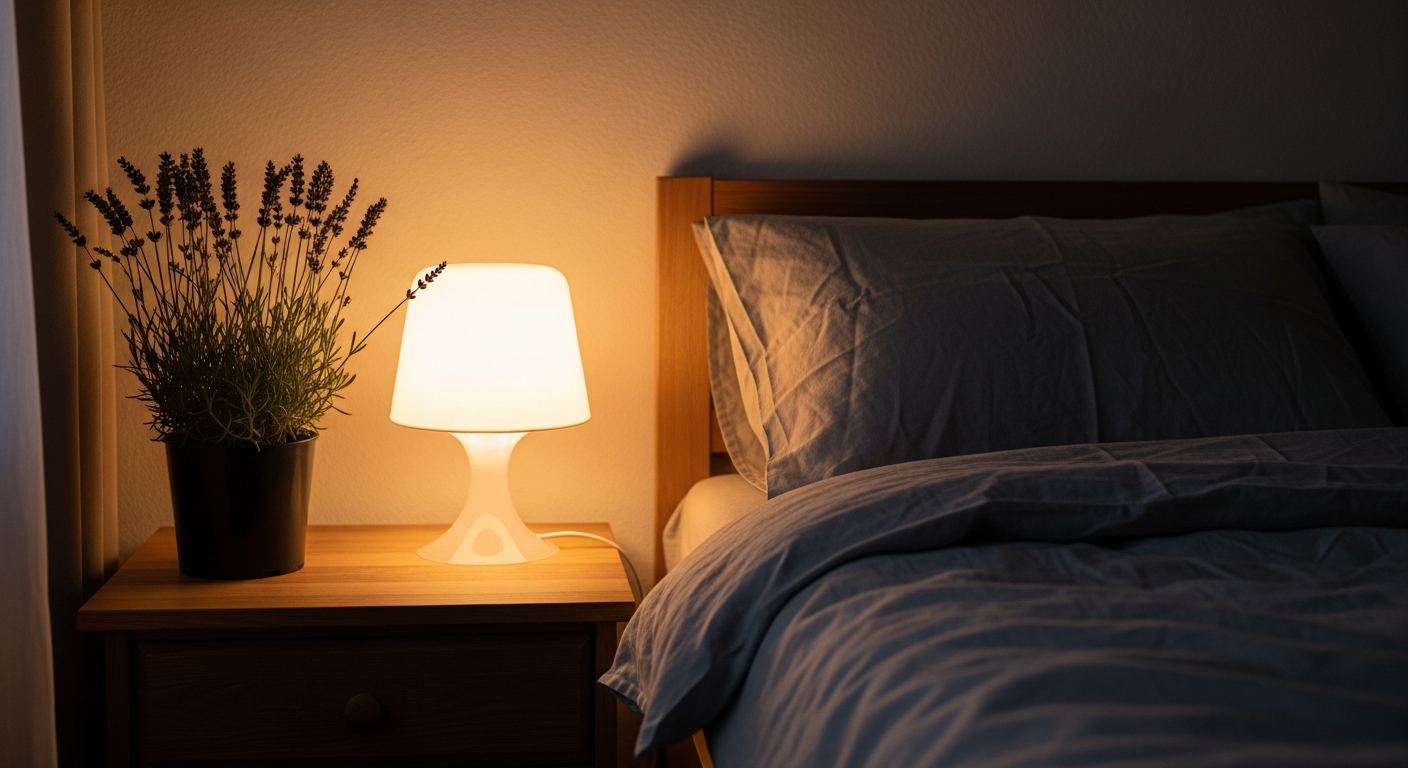
How to Fix Your Sleep in 7 Days
A practical, day-by-day protocol for resetting your sleep. based on circadian science, tested by our team, and surprisingly simple.
 The Rooted Glow Team
 Bad sleep creeps up on you. It starts with one late night, then a few nights of tossing and turning, then suddenly you can’t remember the last time you woke up feeling genuinely rested. You accept it as normal. “I’m just not a good sleeper,” you tell yourself.
We told ourselves the same thing. Then we spent a week implementing a handful of changes based on circadian biology, and every person on our team saw improvement. Not marginal improvement. Falling asleep faster, sleeping deeper, and waking up without an alarm.
This isn’t about supplements or gadgets (though we’ll mention a few). It’s about working with your body’s biology instead of against it.
Why Most Sleep Advice Doesn’t Work
The typical sleep tips you see online (keep your room cool, avoid caffeine) aren’t wrong. They’re just incomplete. They address sleep hygiene without addressing the root issue: a disrupted circadian rhythm.
Your circadian rhythm is the 24-hour internal clock that regulates when you feel awake and when you feel sleepy. It’s controlled primarily by light exposure, and it influences nearly every system in your body, including hormone production, body temperature, digestion, and immune function.
Modern life disrupts this rhythm in specific, predictable ways:
- Insufficient morning light. we wake up indoors, in artificially dim environments
- Excessive evening light. screens, LED bulbs, and overhead lighting suppress melatonin production
- Irregular meal timing. eating late signals “daytime” to your digestive clock
- Inconsistent sleep/wake times. “social jet lag” from different weekend and weekday schedules
- Stimulant dependency. caffeine masks fatigue signals that your body needs you to feel
The 7-day reset addresses each of these systematically.
The 7-Day Protocol
Day 1: Lock Your Wake Time
Pick a consistent wake time that works for your schedule and commit to it. Every day, including weekends.
This is the single most powerful change you can make. Your body’s clock anchors to your wake time, and everything else (when you get sleepy, when you produce melatonin, when your cortisol rises in the morning) cascades from there.
Set an alarm. Get up when it goes off. No snooze button.
Today’s assignment. Wake at your chosen time. Go to bed whenever you naturally feel tired.
Day 2: Morning Sunlight
Within 30 minutes of waking, get outside and expose your eyes to natural sunlight for 10 to 15 minutes. Not through a window (glass filters the UV and blue light spectrum your eyes need). Not wearing sunglasses.
This exposure triggers a cortisol pulse that helps you feel alert and, critically, starts a biological timer that will initiate melatonin production approximately 14 to 16 hours later.
Dr. Andrew Huberman, a neuroscientist at Stanford, has been one of the most prominent voices explaining this mechanism. The research behind it is solid: morning light exposure is the most reliable way to entrain your circadian clock.
On cloudy days, you still get significant lux exposure outdoors (roughly 10,000 lux on a cloudy morning vs. 500 lux from indoor lighting). On genuinely dark winter mornings, a 10,000-lux light therapy box is a reasonable substitute.
Today’s assignment. Continue your locked wake time. Add 10 to 15 minutes of morning sunlight within 30 minutes of waking.
Day 3: Evening Light Control
Starting 2 to 3 hours before your target bedtime, reduce light exposure dramatically.
- Dim overhead lights or switch to warm-toned lamps
- Activate night mode on all screens (this reduces blue light emission)
- Better yet: avoid screens entirely in the last hour before bed
- Consider blue-light-blocking glasses if you must use screens
Bright light in the evening delays melatonin release, which delays sleep onset. This is the single biggest reason people “aren’t tired” at bedtime. Their body hasn’t been given the signal to produce melatonin because the lights in the house are telling their brain it’s still daytime.
Today’s assignment. Continue wake time and morning light. Add evening light dimming starting 2 to 3 hours before bed.
Day 4: Caffeine Cutoff
Move your last caffeine intake to before noon (or 1 PM at the latest, depending on your sensitivity).
Caffeine has a half-life of 5 to 6 hours. This means that a 2 PM coffee still has 50% of its caffeine circulating at 7 to 8 PM. That residual caffeine doesn’t just delay sleep onset. It reduces the proportion of deep sleep even if you fall asleep on time.
A study from the Journal of Clinical Sleep Medicine found that caffeine consumed 6 hours before bedtime still reduced total sleep time by over an hour.
You don’t need to quit caffeine. Just front-load it.
Today’s assignment. Continue all previous changes. Move caffeine cutoff to noon.
Day 5: Meal Timing
Finish your last meal at least 2 to 3 hours before bedtime.
Digestion requires significant metabolic activity. Eating close to bedtime raises core body temperature (the body needs to cool down to initiate sleep), activates the digestive system (which has its own circadian clock), and can cause acid reflux or discomfort that disrupts sleep.
A light snack is usually fine. A full dinner at 10 PM is not.
Today’s assignment. Continue all previous changes. Finish dinner 2 to 3 hours before bed.
Day 6: Create a Wind-Down Ritual
The transition from wakefulness to sleep shouldn’t be abrupt. Your nervous system needs a signal that the day is ending.
Build a 30 to 60 minute wind-down routine. It doesn’t matter exactly what you do, as long as it’s calm, screen-free, and consistent:
- Reading a physical book
- Gentle stretching or yoga
- Journaling (writing down tomorrow’s to-do list is especially effective at reducing pre-sleep anxiety)
- Taking a warm shower or bath (the subsequent temperature drop when you step out mimics the body’s natural cooling signal for sleep)
- A skincare routine (our team finds this meditative)
- Herbal tea (chamomile, passionflower, or valerian root)
The consistency matters. When your brain associates these activities with bedtime, it starts preparing for sleep automatically.
Today’s assignment. Continue all previous changes. Add a 30 to 60 minute screen-free wind-down before bed.
Day 7: Optimize the Environment
Fine-tune your sleep environment:
Temperature. 65 to 68°F (18 to 20°C) is optimal for most people. Your body needs to cool down to initiate and maintain sleep. A room that’s too warm disrupts this process.
Darkness. Complete darkness is ideal. Blackout curtains or a sleep mask. Even small amounts of ambient light (phone charger LED, streetlight through curtains) can suppress melatonin.
Sound. Quiet or consistent background noise. Earplugs or a white noise machine if your environment is noisy. Intermittent noise (traffic, neighbors) is more disruptive than constant low-level sound.
Phone placement. Charge your phone outside the bedroom, or at minimum across the room. The temptation to check it when you wake at 3 AM is removed if reaching it requires getting out of bed.
Today’s assignment. Continue everything. Optimize room temperature, darkness, and sound.
What We Experienced
Our team of five ran this exact protocol. Here’s the honest timeline:
Day 1 to 2. Some grumpiness from the locked wake time (especially team members who usually slept in on weekends). Morning sunlight felt surprisingly good, even on cold mornings.
Day 3 to 4. Evening light reduction was the hardest adjustment. We underestimated how much we relied on screens in the evening. But falling asleep started to feel noticeably easier. Sleep latency (time to fall asleep) dropped from 20 to 30 minutes to under 10 for most of us.
Day 5. The caffeine cutoff was an adjustment. Afternoon energy dipped briefly. We compensated with a short walk instead of reaching for coffee.
Day 7. By the end of the week, every team member reported feeling noticeably more rested. Two members who had been waking at 3 AM regularly were sleeping through the night. Our editor, who had been tracking sleep with an Oura Ring, saw her deep sleep increase by 40 minutes per night.
The most surprising part: it felt easy. Not effortless, but far simpler than the months of sleep supplements and strategies we’d tried before. We were just removing the things that were actively sabotaging sleep and reinforcing the signals our bodies already knew how to respond to.
After the 7 Days
The week establishes the habits. The next 2 to 3 weeks solidify them. Your circadian rhythm takes time to fully recalibrate, so continue the protocol consistently for at least a month.
What we added after the initial week:
- Magnesium glycinate before bed. 300 to 400 mg. This is one of the few supplements with solid evidence for sleep quality improvement. Glycinate is the form best absorbed and least likely to cause digestive issues.
- Tart cherry juice. a small glass with dinner. It contains natural melatonin precursors and has modest evidence for improving sleep onset and duration.
- Consistent exercise timing. morning or early afternoon workouts support sleep. Late-evening intense exercise can delay sleep for some people.
When to Seek Help
This protocol works for garden-variety sleep issues caused by lifestyle factors. It won’t resolve clinical sleep disorders:
- If you snore heavily and feel unrested regardless of sleep duration, you may have sleep apnea. See a doctor.
- If you consistently can’t fall asleep despite good sleep hygiene, you may have a circadian rhythm disorder.
- If your insomnia is driven by anxiety or depression, addressing the mental health component (with a therapist, medication, or both) may be necessary alongside these environmental changes.
Sleep is too important to accept chronic problems as normal.
For the bigger picture of how sleep connects to stress and skin health, see our wellness triangle guide.
Keep Reading

8 Adaptogens That Actually Work
Cutting through the hype: 8 adaptogenic herbs with real research behind them, what they do, how to take them, and what we actually noticed.
Toxin-Free Living: Where to Start
A practical guide to reducing daily toxin exposure. The biggest culprits in your home, the swaps that matter most, and how to prioritize.
Sleep, Stress, and Skin: The Wellness Triangle
How sleep quality, stress levels, and skin health form a deeply connected triangle, and why improving one often improves the other two.
Stay Rooted
Weekly reads on whole-food nutrition, movement, and the K-Beauty routines we actually use. No spam, no fluff. just things worth reading.