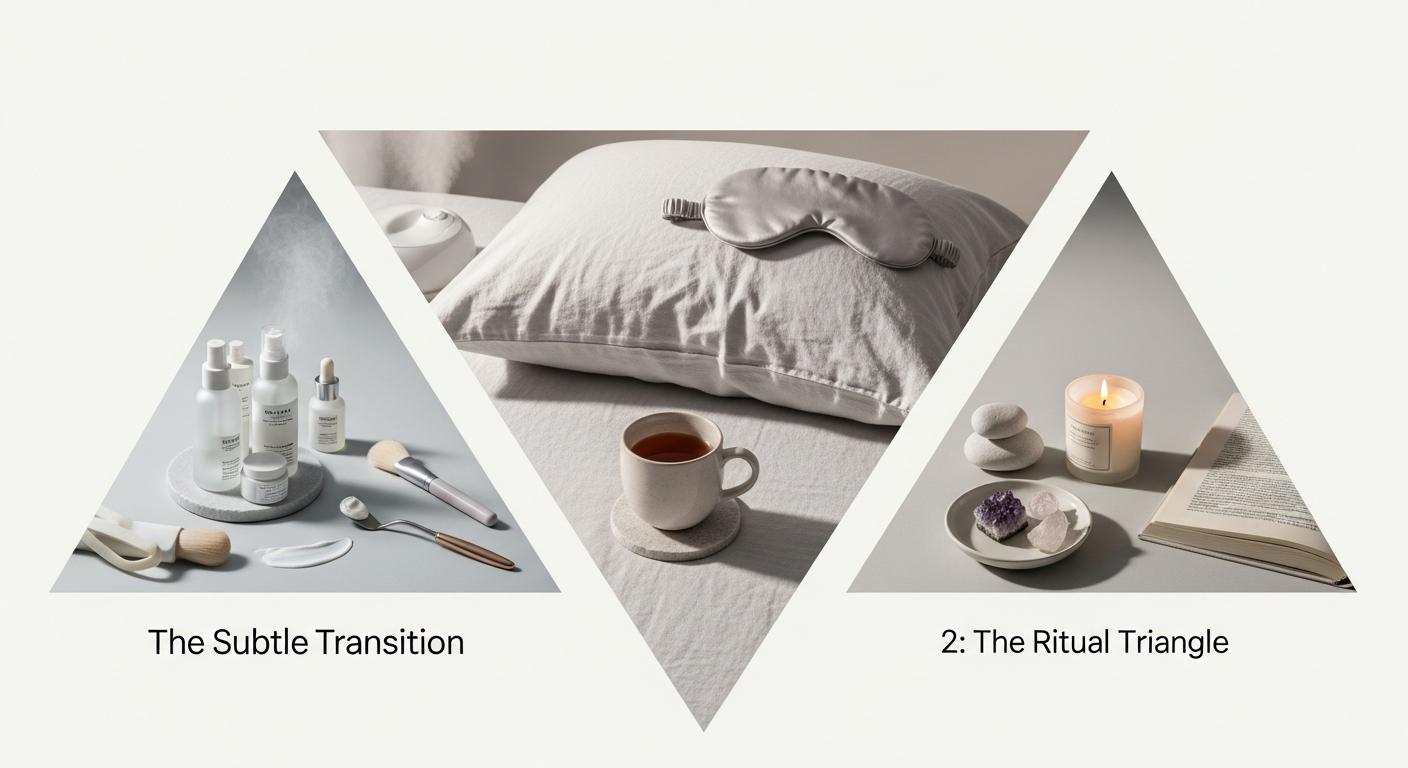
Sleep, Stress, and Skin: The Wellness Triangle
How sleep quality, stress levels, and skin health form a deeply connected triangle, and why improving one often improves the other two.
 The Rooted Glow Team
 For months, our editor was stuck in a frustrating cycle. Stressful work weeks caused poor sleep. Poor sleep made her skin break out. Breaking out made her more stressed. More stress worsened her sleep. And round it went.
Every fix she tried addressed one problem in isolation. A new serum for the breakouts. Melatonin for the sleep. Deep breathing for the stress. None of it worked because she was treating symptoms of a system that was out of balance.
Then she changed her approach. Instead of targeting one corner of the problem, she addressed all three simultaneously. Within six weeks, her skin was clearer, she was sleeping through the night, and her stress felt manageable for the first time in months.
That experience taught us something we keep coming back to: sleep, stress, and skin aren’t separate issues. They’re a triangle. Pull one corner and the other two move. Fix one corner, and the others often follow.
The Biology Behind the Triangle
This isn’t wellness philosophy. It’s physiology. Sleep, stress, and skin are connected through measurable biological pathways.
Cortisol: The Common Thread
Cortisol is your primary stress hormone. It’s produced by the adrenal glands and regulated by the hypothalamic-pituitary-adrenal (HPA) axis. In acute doses, cortisol is healthy and necessary. It helps you wake up in the morning, respond to danger, and manage inflammation.
Chronic elevated cortisol, the kind produced by ongoing stress, poor sleep, or both, is destructive:
On sleep. Cortisol follows a natural daily rhythm: high in the morning, low at night. Chronic stress flattens this curve, keeping cortisol elevated in the evening when it should be dropping. Elevated evening cortisol directly inhibits melatonin production, making it harder to fall asleep and reducing sleep quality.
On skin. Cortisol increases sebum production (leading to breakouts), breaks down collagen (accelerating aging), impairs the skin’s barrier function (causing dryness and sensitivity), and delays wound healing (making blemishes last longer). A 2017 study in Inflammation and Allergy Drug Targets found that cortisol levels were significantly higher in patients with acne compared to matched controls.
On stress itself. Sleep deprivation increases cortisol production the following day by 37 to 45%, according to research from the University of Chicago. This creates a feed-forward loop: stress causes poor sleep, poor sleep increases cortisol, higher cortisol causes more stress.
The Immune Connection
Sleep is when your immune system does its most intensive maintenance work. During deep sleep (slow-wave sleep), your body releases cytokines that regulate inflammation and immune response. Sleep deprivation reduces these protective cytokines while increasing pro-inflammatory markers.
Your skin is an immune organ. It’s constantly defending against bacteria, environmental toxins, and UV damage. When your immune system is compromised by poor sleep and chronic stress, your skin’s defensive capacity drops. This is why you break out after a bad week, get cold sores when you’re exhausted, and notice your complexion looking dull after a stressful period.
The Melatonin-Skin Connection
Melatonin isn’t just a sleep hormone. It’s also a potent antioxidant that your skin uses for overnight repair. Research published in the International Journal of Molecular Sciences shows that melatonin protects against UV damage, supports DNA repair in skin cells, and has anti-aging properties.
When your sleep is disrupted and melatonin production is compromised, your skin loses access to this nightly repair process.
The Sleep Corner
Sleep is the foundation of the triangle. When sleep is good, stress resilience improves and skin repair functions optimally. When sleep is bad, everything cascades.
What Good Sleep Actually Means
It’s not just about hours in bed. Sleep quality matters as much as quantity:
- 7 to 9 hours for most adults (individual needs vary)
- Consistent timing. going to bed and waking up at the same time, including weekends
- Sufficient deep sleep. the restorative slow-wave sleep stages where physical repair happens
- Minimal awakenings. waking once during the night is normal. Waking 4 to 5 times isn’t
If you’re not sleeping well, that’s the first corner to fix. We have a complete guide on how to fix your sleep in 7 days.
The Stress Corner
Some stress is unavoidable. The goal isn’t elimination. It’s developing the capacity to process and recover from stress effectively.
Acute vs. Chronic
Acute stress (a deadline, a cold plunge, a challenging workout) is healthy. Your body responds, adapts, and recovers stronger. This is hormesis, and it builds resilience.
Chronic stress (ongoing work pressure, financial anxiety, relationship conflict, doom-scrolling) keeps your stress response activated without recovery. This is what degrades sleep, damages skin, and erodes health.
The strategies that work aren’t complicated. They’re just hard to prioritize:
- Daily movement. walking, particularly, helps metabolize stress hormones
- Time in nature. 20 minutes outdoors reduces cortisol measurably
- Breath work. even 5 minutes of slow, deep breathing shifts your nervous system from sympathetic (fight-or-flight) to parasympathetic (rest-and-digest)
- Social connection. isolation amplifies stress perception
- Boundaries with technology. constant information intake keeps the stress response active
Adaptogens
Certain herbs, called adaptogens, have been shown to help the body moderate its stress response. We explore the best-studied ones in our guide on 8 adaptogens that actually work.
The Skin Corner
Your skin is a mirror of your internal state. When sleep and stress are out of balance, skin is often the first place you notice.
What Happens to Skin Under Stress
- Increased sebum production leads to clogged pores and breakouts
- Impaired barrier function causes dryness, sensitivity, and reactivity
- Reduced collagen synthesis accelerates fine lines and loss of firmness
- Slower cell turnover results in dullness and uneven texture
- Heightened inflammation triggers redness, rosacea flares, and eczema patches
What Happens During Sleep
Your skin does its heavy lifting between 10 PM and 2 AM:
- Blood flow to the skin increases by up to 30%, delivering oxygen and nutrients
- Cell division peaks during deep sleep, producing new skin cells to replace damaged ones
- Growth hormone surges stimulate collagen production and tissue repair
- Melatonin production provides antioxidant protection against the day’s UV and environmental damage
- Cortisol drops to its lowest levels, allowing repair processes to proceed without interference
Missing this window consistently is like skipping the maintenance cycle on a machine. Things deteriorate.
Breaking the Cycle
If you’re stuck in a negative triangle (bad sleep, high stress, unhappy skin), here’s how to start unwinding it:
Fix Sleep First
Sleep has the highest leverage. Improved sleep reduces cortisol, improves skin repair, and builds stress resilience simultaneously. It’s the corner that influences the other two most powerfully.
Start with our 7-day sleep reset guide.
Reduce One Stressor
You can’t eliminate all stress at once. But you can identify one major stressor and take one action to reduce it. Maybe that’s setting a boundary at work, reducing screen time before bed, or having a conversation you’ve been avoiding.
Support Your Skin From Both Sides
Inside. Eat anti-inflammatory foods, stay hydrated, cut excess sugar and alcohol.
Outside. Keep your skincare simple and gentle. A basic routine (gentle cleanser, hydrating serum, moisturizer, sunscreen) is enough when you’re also fixing the internal foundations. Don’t add aggressive actives to already-stressed skin.
The Positive Spiral
The triangle works both ways. When one corner improves, the others tend to follow:
Better sleep leads to lower cortisol. Lower cortisol leads to calmer skin. Seeing your skin improve reduces stress. Less stress leads to better sleep.
This positive spiral is real, and it gains momentum. The hardest part is the first two weeks of consistent effort before the results become visible. After that, the system reinforces itself.
Further Reading
This is our natural health hub. Go deeper on any of these topics:
Keep Reading

8 Adaptogens That Actually Work
Cutting through the hype: 8 adaptogenic herbs with real research behind them, what they do, how to take them, and what we actually noticed.
Toxin-Free Living: Where to Start
A practical guide to reducing daily toxin exposure. The biggest culprits in your home, the swaps that matter most, and how to prioritize.
How to Fix Your Sleep in 7 Days
A practical, day-by-day protocol for resetting your sleep. based on circadian science, tested by our team, and surprisingly simple.
Stay Rooted
Weekly reads on whole-food nutrition, movement, and the K-Beauty routines we actually use. No spam, no fluff. just things worth reading.